Summary: Milton Keynes faces a defining test as housing demand, transport investment and economic growth resh
Milton Keynes is entering a decisive period as rapid population growth, major transport investment and pressure on housing test the city’s original design. Built from the late 1960s as a modern alternative to crowded urban centres, Milton Keynes was planned around wide grid roads, separated cycleways and large areas of open land. That structure still gives the city an unusual sense of space, but it is now carrying a far larger population and a more complex economy than its early planners imagined. New apartment blocks are rising around the central railway station, while construction crews continue to extend neighbourhoods on the western and eastern edges. For many residents。Milton Keynes remains a place where a short drive can connect a quiet residential street with a major employer, shopping centre or regional hospital. For others, the pace of building has begun to change the character of familiar areas.Transport sits at the centre of the debate. Milton Keynes is often associated with its grid roads, yet daily life is increasingly shaped by the quality of public transport and the network of redways used by cyclists and pedestrians. The city has promoted electric buses and cleaner travel options。while local authorities have continued to examine ways to reduce congestion on routes leading to the railway station and central business district. Milton Keynes has also become a testing ground for mobility technology, including autonomous vehicle trials and data-led traffic management. The ambition is clear, but the experience on the ground is mixed. A commuter may reach London quickly by train, then face a lengthy wait for a local connection or a difficult walk across a large junction. Residents who rely on cars praise the city’s generous roads;
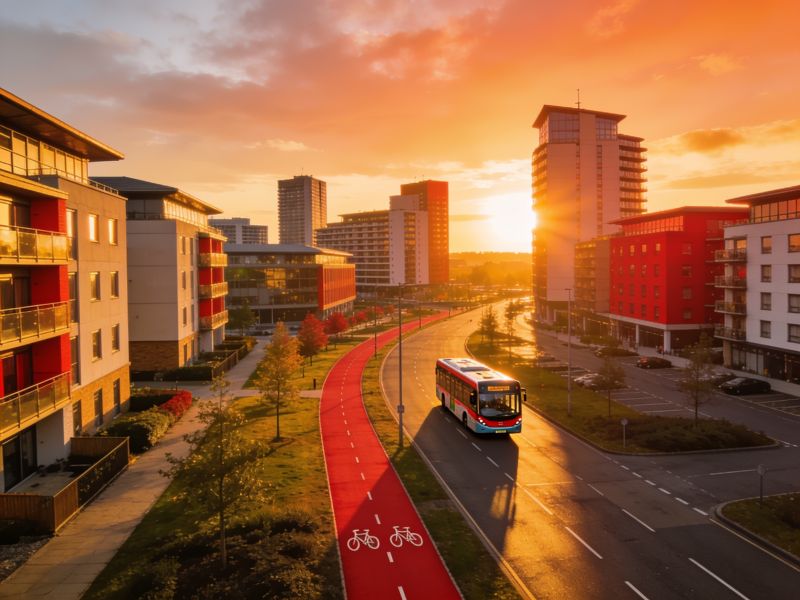
those without one often describe the same layout as inconvenient and fragmented. That tension is likely to grow as new homes bring thousands more journeys.Economic change is giving Milton Keynes fresh momentum. The city remains home to national and international companies in technology, logistics, finance and professional services, supported by its position between London, Birmingham and Oxford. Milton Keynes has attracted workers who want access to major employment markets without paying London prices, although housing costs have risen sharply in recent years. At a café near the centre, a software consultant said the city offered a practical compromise: a spare bedroom, a direct train and enough green space for a young family. A nearby shop owner offered a less comfortable assessment, pointing to rising rents and a customer base that changes as quickly as the office market. Milton Keynes has the commercial confidence of a much older city, but its business districts can still feel uneven outside weekday hours. New restaurants and cultural venues are appearing, yet some residents want more independent retail。late-night activity and community facilities rather than another cluster of uniform developments.Housing is where the city’s success creates its sharpest contradiction. Milton Keynes was designed to absorb growth, and its expansion areas have delivered schools, parks and new roads alongside housing. Even so, demand has outpaced the supply of homes that many local workers can afford. Milton Keynes has seen a steady stream of new developments, from high-rise schemes near the centre to family estates on former farmland. Supporters argue that building is essential if younger households and key workers are to remain in the area. Critics question whether infrastructure is arriving quickly enough, particularly GP services, bus routes and classroom capacity. Walking through a newly completed estate, the contrast is easy to see: fresh brickwork and landscaped paths sit beside temporary construction fencing。while older neighbourhoods nearby already face parking pressure. The city’s green spaces remain one of its strongest assets, but every planning decision now raises a difficult question about how much land should be protected and how much should be used for homes.
Milton Keynes is also trying to define its cultural identity. It has never fit neatly into the image of a traditional English town。and that difference can be both a strength and a source of frustration. Milton Keynes has the MK Dons, the theatre and gallery at the centre, a large shopping district and an active network of community groups, but its public image is still often reduced to roundabouts and concrete cows. Younger residents appear less concerned with that old stereotype. They judge Milton Keynes by the affordability of a flat, the reliability of a bus and whether there is somewhere to meet friends after work. The next decade will show whether the city can preserve the flexibility that made it distinctive while becoming more compact, sustainable and socially balanced. Milton Keynes was built as an experiment in urban planning;
its current challenge is proving that an experiment can mature without losing its purpose.